Pages

Showing posts with label massage therapist. Show all posts

Monday, 21 January 2013

Benefits of Combining Chiropractic Care and Massage Therapy


Chiropractic is based on the belief that your body can keep itself healthy if your spine, neck, and head are properly aligned and healthy. Murray Utah Chiropractors work with spinal structures, correcting abnormalities or injuries to speed healing of nerve, joint and muscular problems that arise from the misaligned bones. But the spine is also surrounded by soft tissue – muscle and tendons that control the movement and flexibility of the spine, and may either cause or exacerbate the structural problems. "Tight" muscles or torn ligaments can prolong spinal problems and postpone healing. Massage therapy can be useful in relieving these kinds of soft tissue problems.

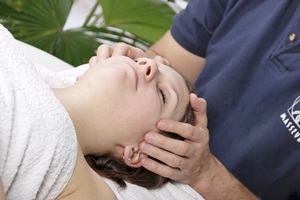
In the simplest terms, chiropractors work with bones and massage therapists work with muscles. But as treatment modalities, they are both compatible and complementary. Massage is often recommended along with chiropractic treatment, either before an adjustment or afterwards, as part of a longer treatment regimen. This combination of treatments often produces much more effective results, and much faster healing in the patient. One of the reasons for this is that both chiropractic and massage share a similar goal – helping you to achieve a state of total well-being, not simply relief from immediate symptoms.

Massage is often recommended as a preparation for a chiropractic adjustment because it relieves the muscle tension that may be pulling joints out of alignment and makes it easier to move them back into place. Massage is also relaxing, and a relaxed body is easier for the chiropractor to work with. In addition, as the chiropractor corrects the structural problems that are causing pain or limiting your mobility, massage can complement the healing process by stretching and relaxing muscles that have been aggravated by these structural problems, making it easier for you to stretch and exercise, and thus more quickly achieve a state of normal well-being.

Many chiropractors work hand-in-hand with massage therapists because their treatment modalities are so complementary. Patients who sought relief from massage therapists for pain, but find that it persists, may often be helped by receiving chiropractic adjustments. Chiropractic patients often find that their treatment proceeds faster and with less discomfort when the soft tissue has been relaxed with massage. Recovery – especially from conditions that cause pain – is normally faster and more complete when multiple components of that pain are addressed simultaneously, the chiropractor working to resolve the structural problems and the massage therapist working to resolve the soft tissue problems. Most chiropractors and massage therapists who work together collaborate to find the proper combination of chiropractic adjustments and massage to get you back to a feeling of health and well-being as quickly as possible.

Both chiropractic and massage therapy are holistic treatment modalities because they share a common goal of treating the whole body, helping you to achieve this state of well-being without drugs or surgery. Both focus on trying to resolve the underlying cause of your pain or discomfort rather than treating isolated symptoms. When they are used in combination, a synergy occurs that is often far more effective than either approach on its own.

Wednesday, 16 January 2013

What Causes Muscle Knots and How to Get Rid of Them


Most people are intimately familiar with muscle knots, which are more formally known as myofascial trigger points. Muscle knots happen when a muscle contracts around a hyper irritable spot and will not release, causing hard nodules or bands to form, along with tenderness, stiffness and pain. These trigger points may also be the source of referred pain, which is when the pain felt in one part of the body is actually being caused by a trigger point elsewhere.

While the exact cause of muscle knots is not yet known, they most often appear when an individual is under stress, either physical or psychological. Chronic or sudden muscle strain, injuries, accidents, infections, being sedentary and smoking are also some leading causes. 

They involve just a small area of muscle tissue that continually contracts. Though the area is small, it can radiate pain to larger areas, even to areas that contain no muscle—such as the joints—as the contracting muscle may pull on tendons and ligaments in a joint area. In some cases this may make it feel as though the pain is originating in the joint.

Muscle knots will often appear after a muscle spasm, and those knots then create a muscle spasm elsewhere, leading to more knots, in a sort of endless loop. A contracted muscle reduces the blood supply to the area, creating an even greater problem, since muscles deprived of oxygen-rich blood create lactic acid, which irritates the nerves and adds to the feeling of soreness in the muscle. You will probably find that your particular trigger points are always located in the same places, such as one point in your shoulder that always seems to be knotted when you are under stress.

Muscle knots can be a key cause of headaches, neck and back pain. A trigger point map can show you the more than 600 different trigger points on the body, which everyone has in the same location, whether they are active or latent.

To help avoid the formation of knotted muscles, there are a few things you can do. Relaxation is important, and learning how to better manage stress can help a lot. Learning some breathing techniques is useful in handling stress, as are meditation and exercise. Also, be sure you drink enough water, as it can flush out the toxins that tend to accumulate in the muscles. Nutrition can help too—getting sufficient amounts of potassium and calcium in your diet is essential for the health of your muscles. Eat a banana once in a while to get a good supply of potassium, and if you eat a lot of green leafy vegetables, you can be sure to get enough calcium.

Stretching and yoga are both helpful in keeping muscles limber and stretched so they are less likely to spasm and knot up. Many chiropractors and massage therapists are also trained in trigger point therapy and specialize in relieving knotted muscles. This means they can help you can break the cycle of muscle knots and spasms, allowing you to proceed through your day pain-free.


About the Author:

Dr. Matt Ramirez graduated with a degree in Bachelor of Human Biology in 2004 and received his Doctor of Chiropractic Degree in 2006. If you are looking for a massage therapist Salt Lake City, Dr. Matt is the one. He also specializes in auto injury recovery and rehabilitation and has enhanced and improved thousands of lives as well as treated people of all ages over the years. He is also an expert in health and wellness, massage therapy, chiropractic care, and more...